
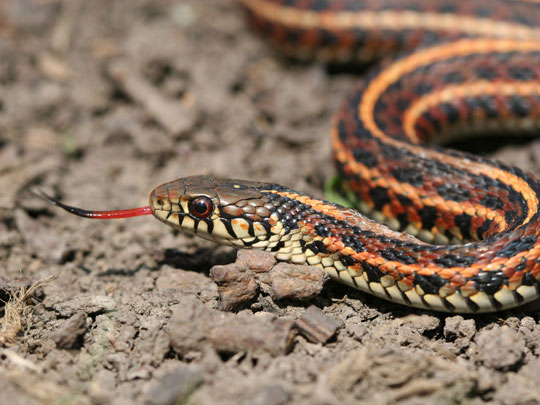
Eastern Plains Garter Snake
Thamnophis r. radix
Good Grabbers about the Eastern Plains Garter Snake:
- They are prey to several birds (herons, bitterns, hawks) and mammals (racoons, skunks, foxes and domestic cats).
They have a defense similar to the skunk - they release feces and musky secretions from the cloaca.
Eastern Plains Garter snakes can be black, gray, dark brown, or olive and their middorsal stripe can vary from bright yellow to vivid orange and any shade in between. The ventral or belly scales are typically a pale greenish gray to almost pearlescent white. In DuPage County, the Plains garter is often confused with the Eastern and/or Chicago garter snake, but it can be distinguished by the unbroken dorsal lateral lines and the pronounced vertical bars between the upper labial scales. Adult snakes reach lengths between 15 and 33 inches and males are typically smaller than females, but have longer tail sections.
While most active during the day—basking and feeding on earthworms or leeches, snails, frogs, toads, and salamanders—they still spend a lot if not most of their time hidden beneath rocks, logs, boards, or other human generated debris. Plains garters are prey to several birds including herons, bitterns, and hawks, also mammals like raccoons, skunks, foxes, and even domestic cats. As a defense, they will release feces and musky secretions from the cloaca.
They maintain a fairly small home range during the active season (April-November), but once winter approaches they travel in search of suitable hibernation sites below the frost line such as cracks in rock outcrops, mammal or crayfish burrows, anthills, house/barn foundations, postholes, wells, rock piles, and the like.
Unlike mammals, reptiles do not “sleep” during hibernation. In fact they can be quite alert albeit sluggish. As ectotherms, their body temperature depends on their surroundings; thus when it is warm their metabolism is accelerated, and when it is cold it slows down significantly. During their winter hibernation a snake’s metabolism has slowed to the point where it uses very little energy and can survive for months without starving.
Mating takes place early spring, soon after emerging from hibernation. Females’ birth litters of 5 to 60 young, which grow quickly within the first two years, reaching maturity by their second spring.
The known population range covers an area from southeastern Minnesota and eastern Iowa through southern Wisconsin and northern Illinois to northwestern Indiana, with some isolated populations in north-central Ohio, southwestern Illinois, and central Missouri. A western subspecies further extends this range to the eastern edge of the Rocky Mountain region.
Its preferred habitat is moist, black prairie soils or open, grassy habitats. It is also often found in meadows near ponds, streams, ditches, marsh edges, or even drier spots—such as vacant lots in cities and suburbs.